
Why 'zero-water' data centers require million dollar local water infrastructure upgrades
The implications of Small Bottle, Big Pipe: Quantifying and Addressing the Impact of Data Centers on Public Water Systems

Dr. Shaolei Ren asked this question in a LinkedIn post 2 weeks ago: “If a facility is ‘zero-water,’ why does its arrival necessitate a $100+ million water system expansion?” 2 weeks later and his team has provided an answer.
The choice of heat exchange processes for data center cooling is a binary one. You either primarily rely on dry cooled processes (HVAC: air cooled heat exchanger), which requires exorbitant amounts of power consumption, or you rely on water cooled processes (evaporative: adiabatic, cooling towers), which require exorbitant amounts of water consumption. A ‘zero-water’ facility primarily relies on dry cooled processes, essentially industrial air conditioning, to exchange the heat from the facility.
Primarily is the key word here, because every facility needs a backup. There are times when dry cooled processes are not feasible. When the outside temperature falls below 18C/64F, the humidity in the air causes condensation concerns. When it rises above 27C/80F, the equipment has to work harder to keep the facility cool. The American Society of Heating, Refrigerating and Air-Conditioning Engineers (ASHRAE), has been providing temperature and humidity standards for data center operations since 2004. These guidelines are meant to help facility operators maintain the operational health of the data center.
So what happens when the outside air is too hot or too humid for dry cooled operations? The facility doesn’t shut down and wait it out. They switch to their backup system, which relies on evaporative cooling. And this is where Dr. Ren and his team’s new paper answers his question. In Small Bottle, Big Pipe: Quantifying and Addressing the Impact of Data Centers on Public Water Systems, the team focuses on a water system’s ability to handle peak daily water withdrawals. Essentially, the local water systems that support data center operations cannot be designed to handle the average of a facility’s annual water withdrawal or discharge, because that annual average is not a realistic estimation of the intensity of the water flow that these utilities will have to manage.
Data centers exhibit substantially higher daily peaking factors - spikes in water flow - than other local facilities. And those spikes are particularly high for dry cooled facilities:
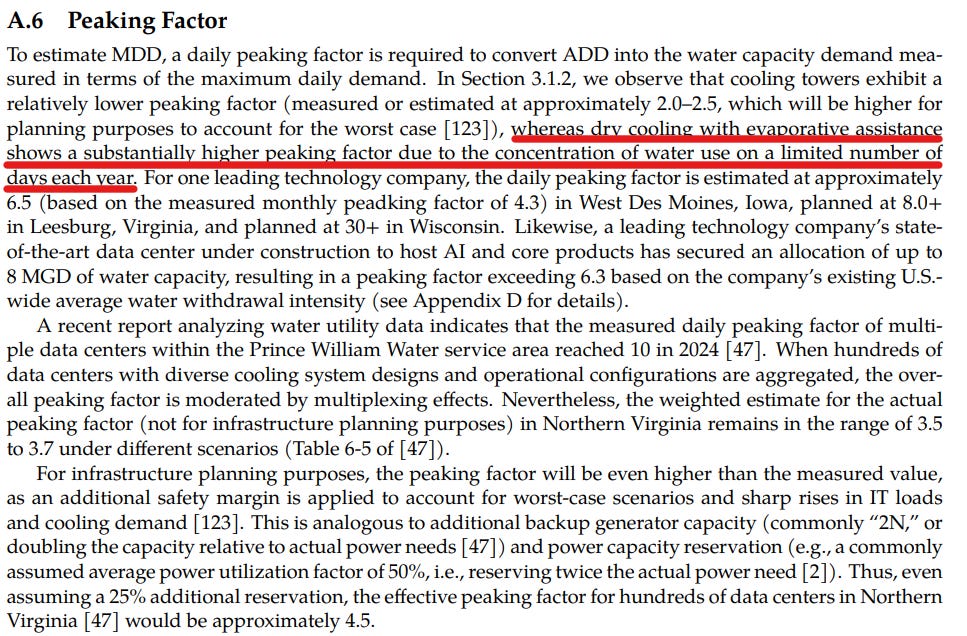
Local utilities have to be designed to handle the spikes. So local communities must upgrade their water withdrawal and wastewater treatment facilities to handle the peak demand of a facility’s water cooled heat exchange processes on the hottest and most humid days of the year. That is why implementing a zero-water’ data center facility comes with a mandatory multi-million dollar local water system expansion. Without it, the city, county, and water district risk catastrophe. On the hottest most miserable day of the year, the data center facility will switch to water cooling, and everyone’s taps will run dry.