
Executive Orders are not law
On the limits of the AI Executive Order

I was having a discussion with my sister about the AI Executive Order (available in the Federal Register) and explaining the issue of preemption, state’s rights, and why this Order doesn’t do what people think it does. She looked at me and said, I don’t think people realize you are a whole lawyer. And, well, maybe people don’t? I almost exclusively write and speak about AI from a technical and ethical perspective, so I can see how it would be easy to forget that I’m an actual attorney. With two law degrees, who owned my own litigation practice years before I ever considered going into tech. So, this substack is an attempt to bring more of my full self to my AI ethics work, and provide more context on the AI Executive Order from a legal perspective.
Executive Order as policy
Executive Orders are not law, at least not when their sole purpose is to question the validity of state and municipal laws. Think of those kinds of EO’s as more like, policy statements.
You can tell the difference between the two by looking at how they are written. When the President has full authority over an area, the Executive Order is written as a mandate. Take the EO on Christmas leave for example (available in the Federal Register):
Section 1. All executive departments and agencies of the Federal Government shall be closed and their employees excused from duty on Wednesday, December 24, 2025, and Friday, December 26, 2025, the day before and the day following Christmas Day, respectively.
The President has full authority over the work schedules of federal government employees, so the EO just says what is to be done. There’s no language establishing Presidential authority in this matter, no explanation of the policy driving the decision-making, no citations of federal rules or regulations, just an order given followed by implementation guidance. This is how an EO that specifically addresses an area of absolute Presidential authority is written - Do the thing.
The structure changes when the EO is for an area that is outside the President’s absolute authority. For example, the Cashless Bail EO (available in the Federal Register):
Section 1. Purpose and Policy. Maintaining order and public safety requires incarcerating individuals whose pending criminal charges or criminal history demonstrate a clear ongoing risk to society. When these individuals are released without bail under city or State policies, they are permitted—even encouraged—to further endanger law-abiding, hard-working Americans because they know our laws will not be enforced. Our great law enforcement officers risk their lives to arrest potentially violent criminals, only to be forced to arrest the same individuals, sometimes for the same crimes, while they await trial on the previous charges. This is a waste of public resources and a threat to public safety.
As President, I will require commonsense policies that protect Americans’ safety and well-being by incarcerating individuals who are known threats. It is therefore the policy of my Administration that Federal policies and resources should not be used to support jurisdictions with cashless bail policies, to the maximum extent permitted by law.
Sec. 2. Consequences for Cashless Bail Jurisdictions. (a) Within 30 days of the date of this order, the Attorney General shall submit to the President, through the Assistant to the President for Homeland Security, a list of States and local jurisdictions that have, in the Attorney General’s opinion, substantially eliminated cash bail as a potential condition of pretrial release from custody for crimes that pose a clear threat to public safety and order, including offenses involving violent, sexual, or indecent acts, or burglary, looting, or vandalism. The Attorney General shall update this list as necessary.
(b) The head of each executive department and agency, in coordination with the Director of the Office of Management and Budget, shall identify Federal funds, including grants and contracts, currently provided to cashless bail jurisdictions identified pursuant to subsection (a) of this section that may be suspended or terminated, as appropriate and consistent with applicable law.
Section 1 isn’t a mandate, it’s a policy statement that explains why the President doesn’t believe cities should provide judges the ability to release criminal arrestees from jail on bail unless they are able to pay a substantial fee to secure their freedom. Notice that Section 1 does not include any ‘shall’ statements. If the President had the authority to overturn cities’ bail decisions, Section 1 would read: “individuals whose pending criminal charges or criminal history demonstrate a clear ongoing risk to society shall not be released from incarceration without bail,” and any additional sections would provide implementation guidance. But the President doesn’t have that authority, which is why Section 1 is not a mandate, and Section 2 isn’t implementation guidance. Instead, Section 2 requires relevant agencies to create a naughty list of cashless bail cities and states, and use their funding authority to try to force cities to change their policies.
So, why can the President mandate a thing when it comes to federal working conditions, but has to use funding as a forcing function when he wants to change a thing based on city or state law? That’s where the discussion of federal preemption and state’s rights comes into play.
State’s rights and Presidential authority
The United States of America is just that, a federation of independent states. As such, the federal government can’t just tell states how to handle their affairs within their borders. There are very specific areas where states have given up their right to self-governance to the federal government, anything outside of those areas are for states to decide for themselves. For example, states control their own policing, which is why there was such an uproar in state and local governments when the President placed troops in American cities as part of his immigration crackdown. The key issue that the courts were asked to decide in the lawsuits around these deployments was whether the troops were being asked to conduct law enforcement activities, in which case the federal government would be overstepping its bounds. Ultimately, the Court decided that the deployments in Los Angeles, California; Chicago, Illinois; Portland, Oregon infringed on those state’s right to police themselves, and declared the military deployments illegal.
Essentially, the US Constitution was a negotiated document. The states gave up some, but not all of their rights. The delegation of power between states and the federal government is specifically delineated by the 10th Amendment to the Constitution (available on Congress.gov):
The powers not delegated to the United States by the Constitution, nor prohibited by it to the States, are reserved to the States respectively, or to the people.
While the Amendment reads as a pretty straightforward statement, it isn’t. It basically set up a ‘use-it-or-lose-it’ process for federal authority. There’s an ongoing a tug of war between the federal government and the states over the extent of power the federal government actually has. Essentially, there are two key requirements for the federal government to exercise full authority over an area: 1) the federal government has to have been delegated power over that area in the Constitution, and 2) the federal government has to have created laws based on its power. When those two conditions are met, federal authority is at its strongest, as explained by Article 6 of the Constitution (available on Congress.gov):
This Constitution, and the laws of the United States which shall be made in pursuance thereof; and all treaties made, or which shall be made, under the authority of the United States, shall be the supreme law of the land; and the judges in every state shall be bound thereby, anything in the Constitution or laws of any State to the contrary notwithstanding.
Article 6 is better known as the Supremacy Clause of the Constitution. Any law that the federal government creates in one of its delegated areas is considered the ‘supreme law of the land.’ So any state or local law that expressly conflicts with those laws is considered invalid. In legal terms, we call this ‘federal preemption.’ There is an entire legal area devoted to this area of law and the various ways a state or local law can be deemed in conflict with a federal law. But, for the purposes of the AI Executive Order, the conditions required for creating a supreme law of the land have not been met. Which is clear from how the EO is written.
Executive Order in the absence of supremacy
I made the following post about the AI Executive Order after it was signed:
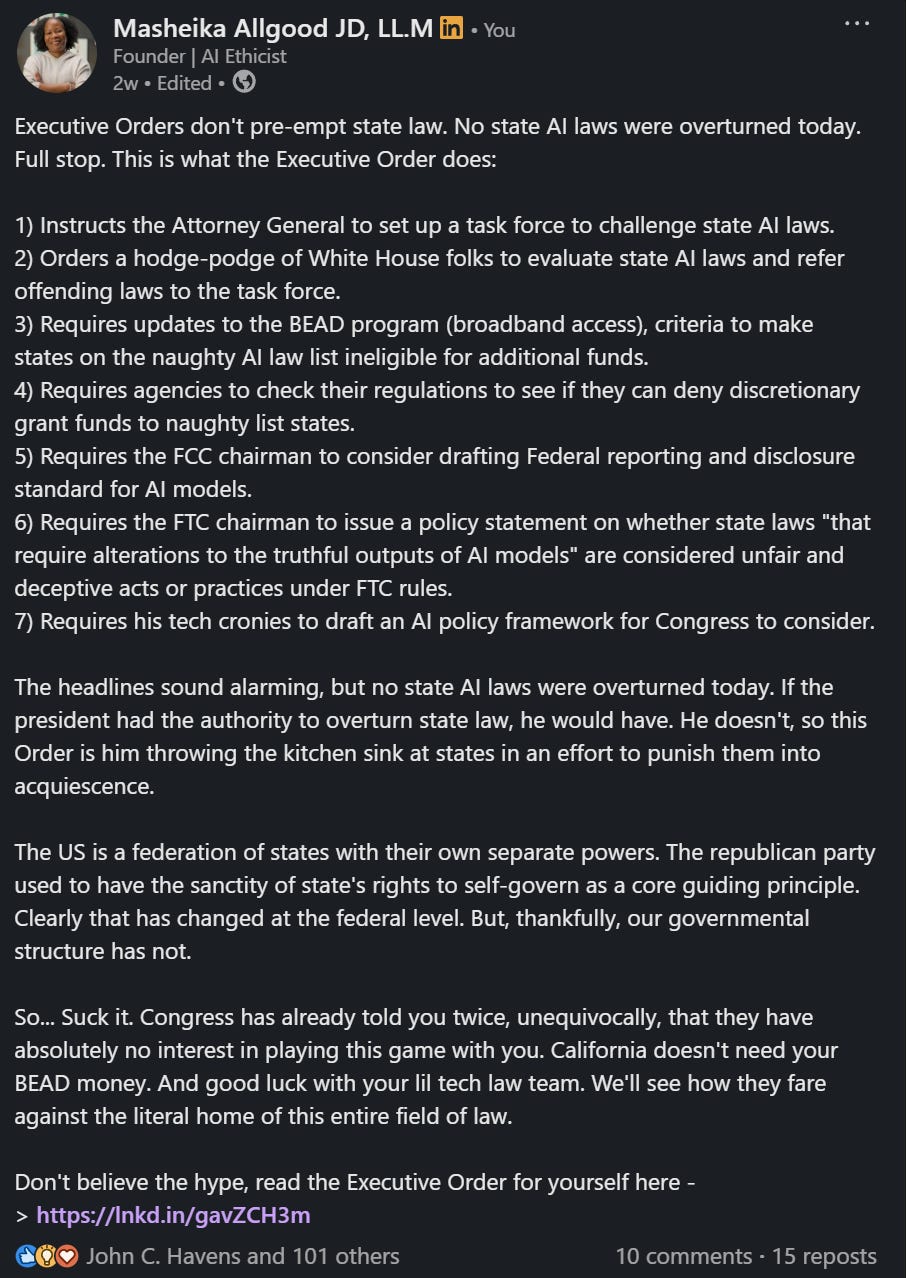
But looking at the EO using the framework from earlier in the discussion, it is clear that the federal government hasn’t met the conditions required to create a supreme law of the land that preempts all state laws. For one, there is no federal law:
Section 1. United States leadership in Artificial Intelligence (AI) will promote United States national and economic security and dominance across many domains. Pursuant to Executive Order 14179 of January 23, 2025 (Removing Barriers to American Leadership in Artificial Intelligence), I revoked my predecessor’s attempt to paralyze this industry and directed my Administration to remove barriers to United States AI leadership. My Administration has already done tremendous work to advance that objective, including by updating existing Federal regulatory frameworks to remove barriers to and encourage adoption of AI applications across sectors. These efforts have already delivered tremendous benefits to the American people and led to trillions of dollars of investments across the country. But we remain in the earliest days of this technological revolution and are in a race with adversaries for supremacy within it.
To win, United States AI companies must be free to innovate without cumbersome regulation. But excessive State regulation thwarts this imperative. First, State-by-State regulation by definition creates a patchwork of 50 different regulatory regimes that makes compliance more challenging, particularly for start-ups. Second, State laws are increasingly responsible for requiring entities to embed ideological bias within models. For example, a new Colorado law banning “algorithmic discrimination” may even force AI models to produce false results in order to avoid a “differential treatment or impact” on protected groups. Third, State laws sometimes impermissibly regulate beyond State borders, impinging on interstate commerce.
My Administration must act with the Congress to ensure that there is a minimally burdensome national standard—not 50 discordant State ones. The resulting framework must forbid State laws that conflict with the policy set forth in this order. That framework should also ensure that children are protected, censorship is prevented, copyrights are respected, and communities are safeguarded. A carefully crafted national framework can ensure that the United States wins the AI race, as we must.
Until such a national standard exists, however, it is imperative that my Administration takes action to check the most onerous and excessive laws emerging from the States that threaten to stymie innovation.
The EO acknowledges that Congress hasn’t created a federal law on AI regulation. So, in accordance with the 10th Amendment, since the Constitution doesn’t specifically delegate AI governance to the federal government nor prohibit it from the states, AI governance falls within the states’ authority.
There is an argument to be made that state AI laws may impinge on interstate commerce - which is an area of specifically delegated federal authority - but that determination is not a given and likely will take years of complex litigation to reach a final supreme court ruling. And the litigation can’t even get started until the federal government passes a law that can be considered the supreme law of the land. Which means getting a bill passed in the US Congress and US House and then signed by the President. Given that the Senate rejected an attempt to pass a moratorium on state AI laws with a 99-1 vote in July, it seems unlikely that a one-AI rule-to-rule-them-all is forthcoming any time soon.
But lack of supremacy over an area doesn’t mean the federal government is powerless. There’s always money. Section 5 threatens non-compliant states with loss of federal funding:
Sec. 5 . Restrictions on State Funding. (a) Within 90 days of the date of this order, the Secretary of Commerce, through the Assistant Secretary of Commerce for Communications and Information, shall issue a Policy Notice specifying the conditions under which States may be eligible for remaining funding under the Broadband Equity Access and Deployment (BEAD) Program that was saved through my Administration’s “Benefit of the Bargain” reforms, consistent with 47 U.S.C. 1702(e)-(f). That Policy Notice must provide that States with onerous AI laws identified pursuant to section 4 of this order are ineligible for non-deployment funds, to the maximum extent allowed by Federal law. The Policy Notice must also describe how a fragmented State regulatory landscape for AI threatens to undermine BEAD-funded deployments, the growth of AI applications reliant on high-speed networks, and BEAD’s mission of delivering universal, high-speed connectivity.
(b) Executive departments and agencies (agencies) shall assess their discretionary grant programs in consultation with the Special Advisor for AI and Crypto and determine whether agencies may condition such grants on States either not enacting an AI law that conflicts with the policy of this order, including any AI law identified pursuant to section 4 or challenged pursuant to section 3 of this order, or, for those States that have enacted such laws, on those States entering into a binding agreement with the relevant agency not to enforce any such laws during the performance period in which it receives the discretionary funding.
This is a tried and true method in American governance. In 1984, Mother’s Against Drunk Driving (MADD) was campaigning for a national drinking age as a way to limit drunk driving incidents. Since the federal government doesn’t have the power to force states to agree to a set drinking age, Congress passed a law that decreed that any state with a drinking age that was lower than 21 would have 10% of the highway funds they received from the federal government withheld. The AI EO attempts to use the same strategy, but without the approval of Congress. Instead of attempting to bring another AI preemption law before a seemingly unwilling Congress, the AI EO bypasses Congress, directly instructing Federal Agencies to declare non-compliant states to be ineligible for funds or to require states to enter into a binding agreement not to enforce their own laws in exchange for receiving federal funding.
So, the AI Executive Order does not declare state AI laws invalid. It doesn’t create a federal AI law. Because the President has no power to do so. Instead, the AI EO is essentially a policy statement by the White House that threatens to possibly withhold federal funding in the hopes that one or more states will willingly hand over their authority to regulate AI. Best of luck with that.